With It We Leave
Horror Level Design
The Prison
Setting the Stage
.png)
In other words, the horror can be enhanced if we utilize poor design choices in extremely specific ways.
Horror and game design have a very interesting and complicated relationship. Tension can be created by utilizing dark patterns.
Accomplishing good use of dark patterns, however, requires almost surgical levels of precision due to how easily it can ruin a game experience.
Design choices that work against the player are often poor design choices, so we need to be absolutely certain that what we are doing will benefit the player's overall experience.
This is where players will start out, so naturally this area is largely designed to allow players to get their bearings on key game mechanics.
The two most important mechanics that need to be taught to the player are regarding the monster.
The player needs to learn that the monster is drawn to noise and the monster is capable of breaking down large gates.
My goal was to go about this without intruding too much on the player's immersion.
We can utilize perspective and visible examples to accomplish this to great effect.
The monster will then proceed to break down the gate closing off the cafeteria in order to investigate that alarming noise.
Most important of all, the player is able to view all of this happening from the position where they press the red button.
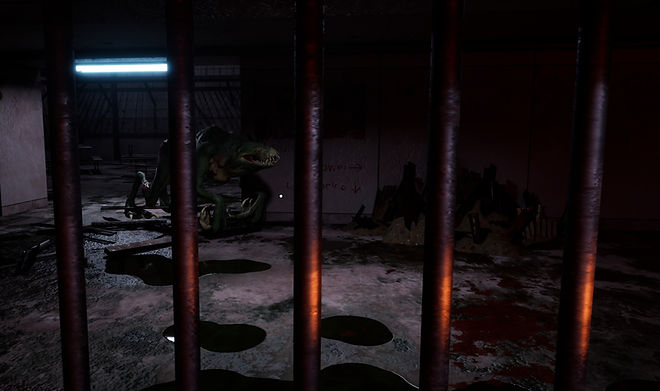
The player sees the monster down below in the cafeteria, and a big red button nearby.
The player will press the button, and a loud alarm can be heard off in the distance.
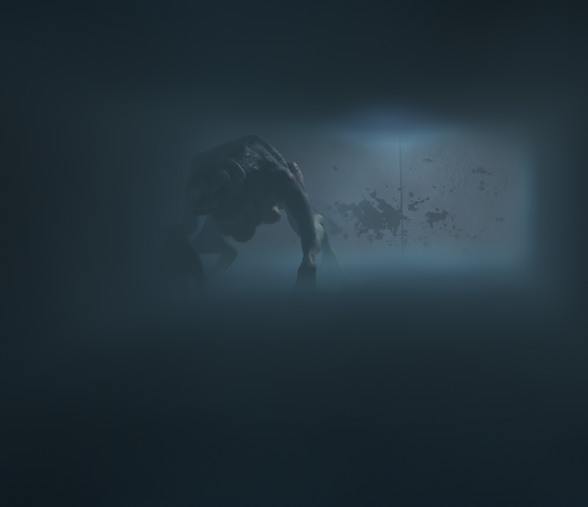

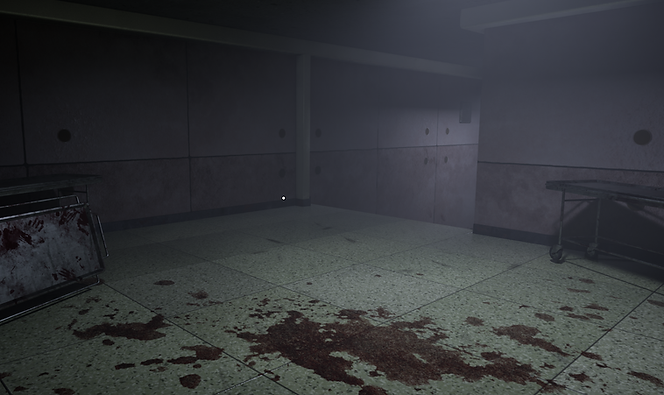
The alarming sound caused the monster to break down the gate in order to reach where the sound is. The player can utilize this in the future to replicate what happens here.
With this method we teach the player not only about how the monster responds to sounds and its ability to break down gates, but we also teach the player how they can go about getting the monster to break those gates.
.png)
The player will eventually find a walkie talkie and enter the second prison block. Here they will encounter yet another breakable gate, but this time there is no button to trigger an alarm of any kind.
Because of the prior lesson we have taught the player about how the monster will interact with gates that block its path, the player can learn on their own terms that the walkie talkie can be used to bait the monster into destroying the gate blocking the player's path.




The Lab
Evolving the Stage
By escaping the prison and making it into the lab, we now know for a fact that the player knows what to do in order to work with the monster to break down those large gates.
So what now?
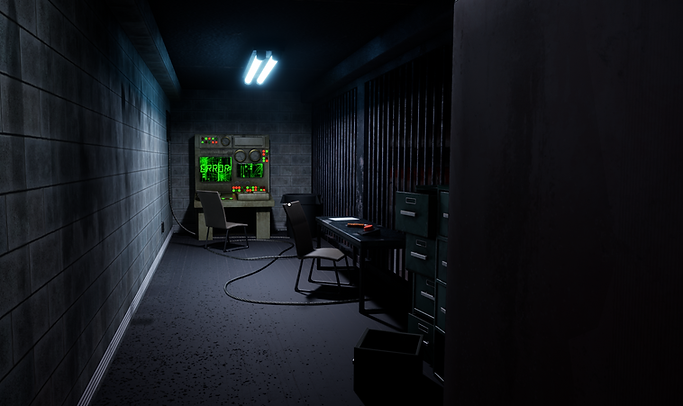
Of course we want to evolve the area the player is interacting with in a way to make it seem more hostile.
However, we also want to be sure that we aren't throwing off the player too much.
.png)
.png)
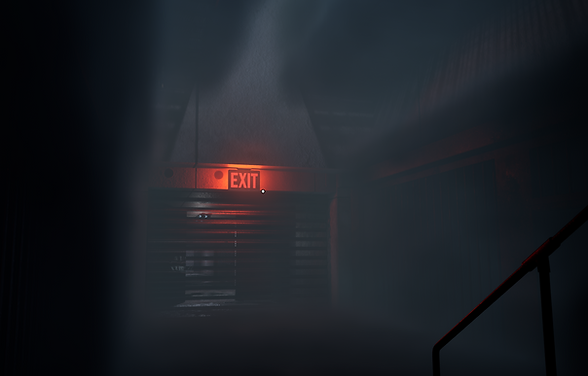
The building the player is in has 3 floors, which means there is a lot of space to get lost in.
The best way to prevent anyone from feeling overwhelmed by the amount of space is by designing it so that the player descends to the bottom floor where the end is.
The main way I figured this could be accomplished is by making the level a little less linear and leaning into a bit more of a labyrinth structure.
There is an ideal player path, but not everyone will align with it perfectly like in the prison level.
The number one challenge is going to be managing how lost the player will get. We want to create tension by having them wander around to find their way, but not too much to the point where it becomes frustrating for them.
My solution? Keeping a consistent direction and placing common indicators for where the player goes to progress.
The idea behind this is so that the player is constantly progressing to lower floors. This creates a better sense of direction since they'll know that they are looking for a way to reach lower depths.